
Every screen below is a real capture from one run against US9730910B2, a patent a US court held obvious in 2022. Nothing is mocked up. The narration walks the screens; the screens do not change.
US9730910B2, Treatment of circadian rhythm disorders, Vanda Pharmaceuticals. Priority 18 Dec 2012.
“The use of a melatonin agonist in the treatment of free-running circadian rhythms in patients, including light perception impaired patients, e.g., blind patients.”
In plain terms: tasimelteon, a melatonin agonist, resets the body clock of people whose light perception is impaired and whose days therefore drift — Non-24-Hour Sleep-Wake Disorder.
The third piece: stop the one drug, then start the other. Rifampicin, an antibiotic, switches on a liver enzyme that clears tasimelteon faster, so the two should not be given together.
Eight of the nine pieces were plainly in the art before December 2012. This one was stated nowhere for tasimelteon. Whether it was still obvious — because the art teaches the same step for ramelteon, a sister compound — is what Vanda v. Teva turned on, and it is the piece you will watch the system hand to the researcher.
Subject, essence and claim text as rendered in the run’s own Section 103 report; the plain-terms gloss is ours.
One piece of the claim stays open to the end. That is the point of the example: no document in the pre-2012 art states that step for tasimelteon. The art teaches it for a sister compound, and getting from one to the other is the inference the court made. The system found that document, graded exactly how far it goes, and handed the inference to the researcher — where the law puts it.
US9730910B2, claim 4Claim 4 is broken into nine limitations and each is tracked on its own.
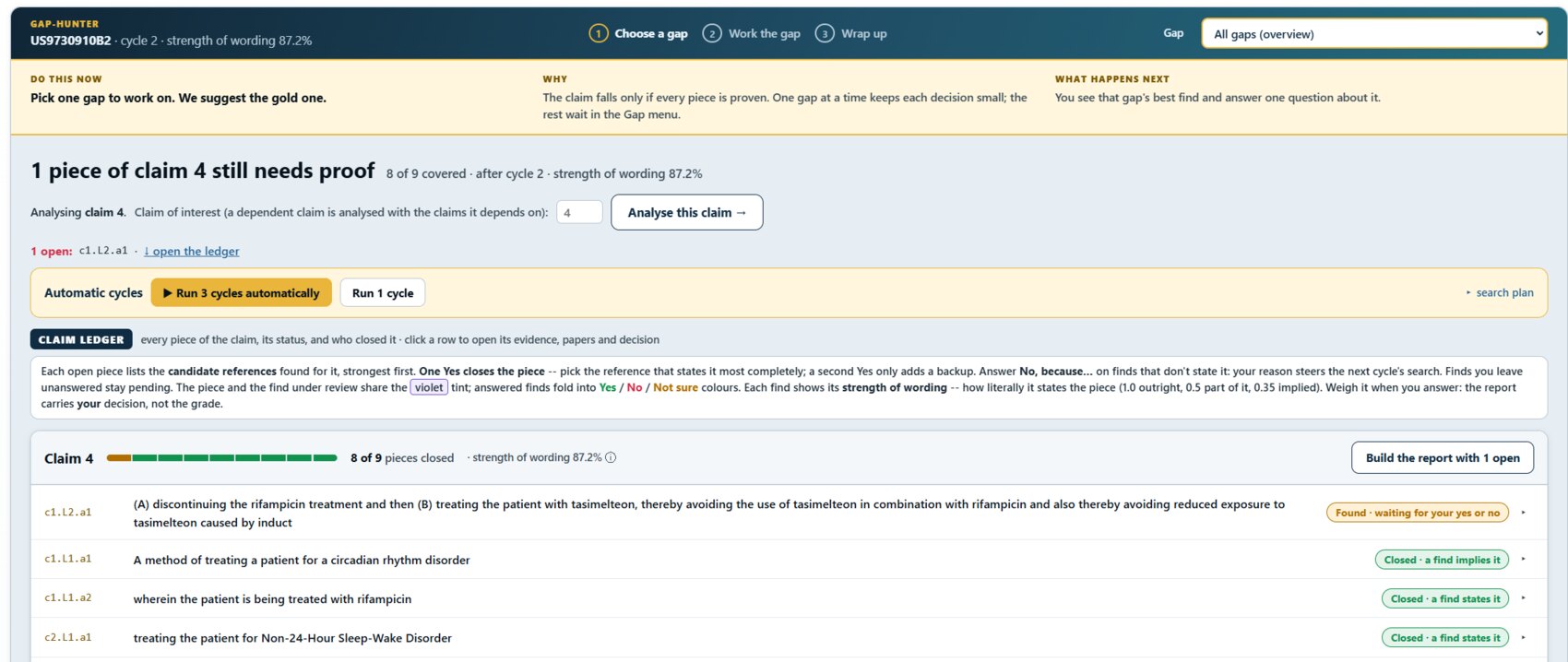
The open piece, the best document found for it, and the system's own reading of that document.
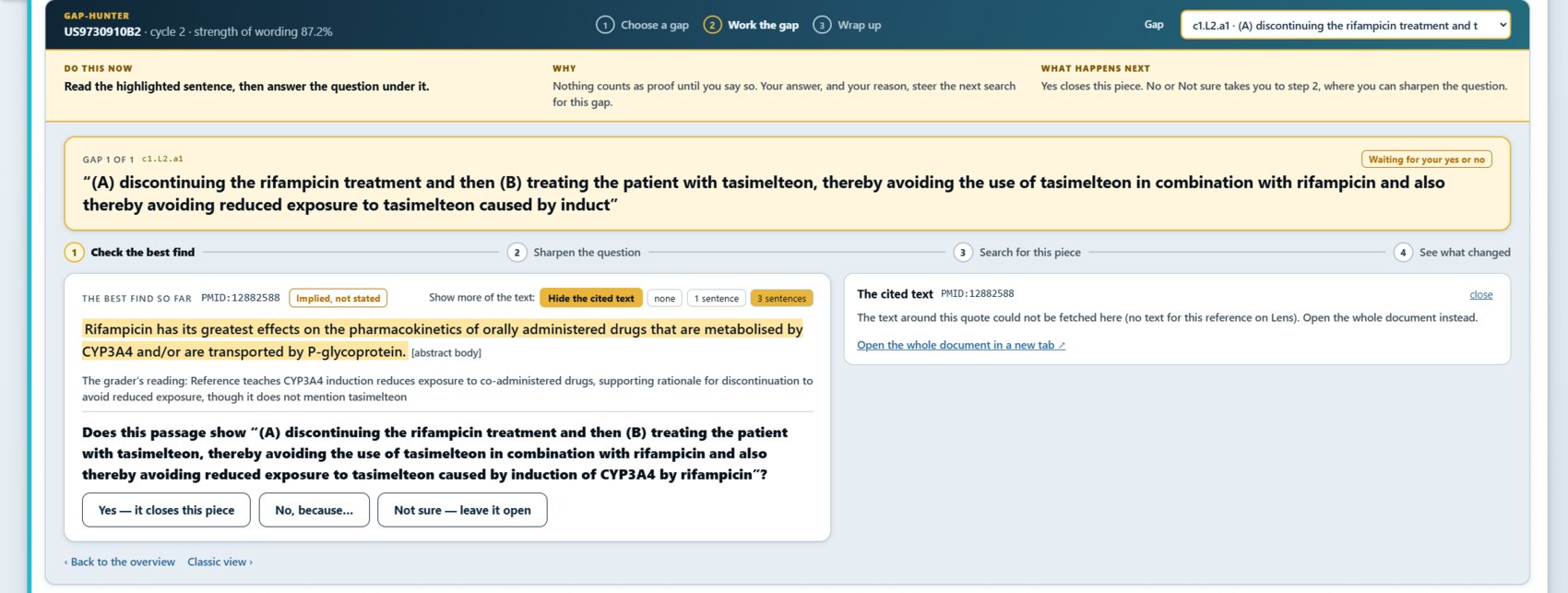
A "no" sends the question back out, and the terms it will use are shown before anything runs.
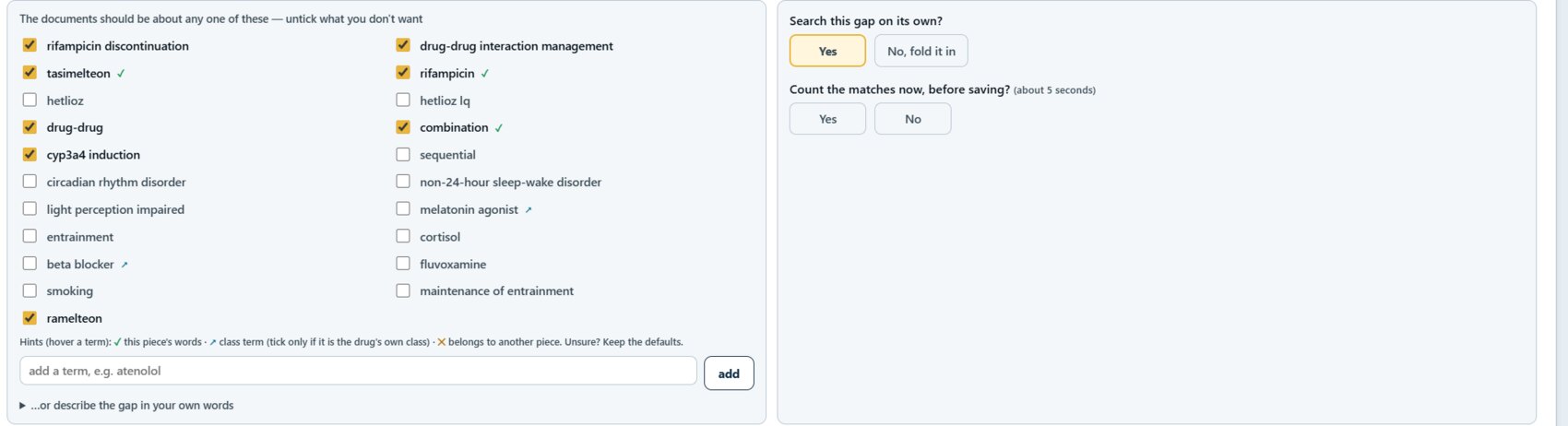
The query is counted against the date gate before it runs.

Four cycles later the run had surfaced WO2007137244A1 — the tasimelteon dosing application the defence entered at trial as DTX 041 — and the pre-2012 ramelteon literature that teaches what rifampicin does to exposure and what happens once it is stopped. Those are the two legs of the obviousness case, and the system reached them from a patent number.
On the piece you just watched, it would not say the art stated the element outright — because the art does not. No pre-2012 document mentions tasimelteon and rifampicin together. The ramelteon papers teach the step for a sister compound on the same metabolic pathway, and the court's obviousness finding rests on exactly that bridge: what is true of ramelteon is true of tasimelteon.
The system found the document that makes the inference possible, graded it honestly as implied rather than stated, and asked the researcher to make the call. The researcher, with the evidence on screen, made the same call the court did. That hand-off is the design, not a gap in it.
Why this exampleEach cycle is one sweep, and each reaches one shelf further out: the filed classes, the neighbouring classes, the mapped scientific libraries, then foreign jurisdictions. Every find is carried back to the ledger; when it states a piece outright, that piece closes.