
In a two-hour run against a patent a US court held obvious in 2022, Gap-Hunter™ surfaced both references the court relied on, graded 323 prior-art documents against the claim's nine limitations — and on the one limitation the case turns on, put the decisive document in front of the researcher with an honest grade, implied, not stated, and asked for the inference the court itself had to make.
Claim 4 of the '910 patent covers treating a circadian rhythm disorder in a patient on rifampicin: stop the rifampicin, then treat with tasimelteon at 20 mg before a target bedtime. The court invalidated it in December 2022, and the Federal Circuit affirmed.
A decided case was chosen on purpose. The references the court relied on are on the public record, so a run against this patent can be scored rather than admired. The litigation, the exhibit numbers and the court's reasoning were not in the input, and every candidate published on or after the priority date was dropped before grading.
| Search cycles | 4 |
|---|---|
| Cycle run times | 49, 22, 22 and 21 minutes |
| Candidate pool after narrowing | 275 documents |
| References graded against the claim | 323 |
| Passing the priority-date gate | 320 |
| Reference-to-limitation judgments | 2,880 |
| Strength of wording, by cycle | 83.3% → 87.2% → 92.8% |
Every one of those 2,880 judgments carries the passage it rests on and a date check. A reviewer can open any of them and see what the grade was based on.
The conventional route runs in sequence: brief a search firm, wait for a reference list, then have attorneys read it and build the claim chart. If the chart is thin somewhere, the search goes back out and the cycle repeats.
| This run | Conventional route | |
|---|---|---|
| Prior-art search | Four aimed cycles, 1 hr 54 min of machine time | A search firm engagement, typically weeks |
| Grading against the claim | 2,880 reference-to-limitation judgments, each carrying its passage and date check | Built by attorneys once the references arrive |
| Re-aiming on what came back | Three more times, the same evening | A second engagement |
Two caveats, both material. The cycles were not independent — each was aimed by a person reading the last, so this is not the speed of an unattended system. And a claim chart is not a brief: what this produces is the evidentiary layer an attorney builds one on.
To argue claim 4 is obvious you need a document teaching the dose and the indication, and a separate document teaching what rifampicin does to tasimelteon exposure and what to do about it. The system located both.
WO2007137244A1 came back in the pool — the published application covering tasimelteon dosing, and the document the defence entered at trial as DTX 041. The second leg came back as the pre-2012 ramelteon literature: a melatonin-receptor agonist on the same metabolic pathway, where the papers state that rifampicin cuts exposure and that the effect resolves once rifampicin is stopped.
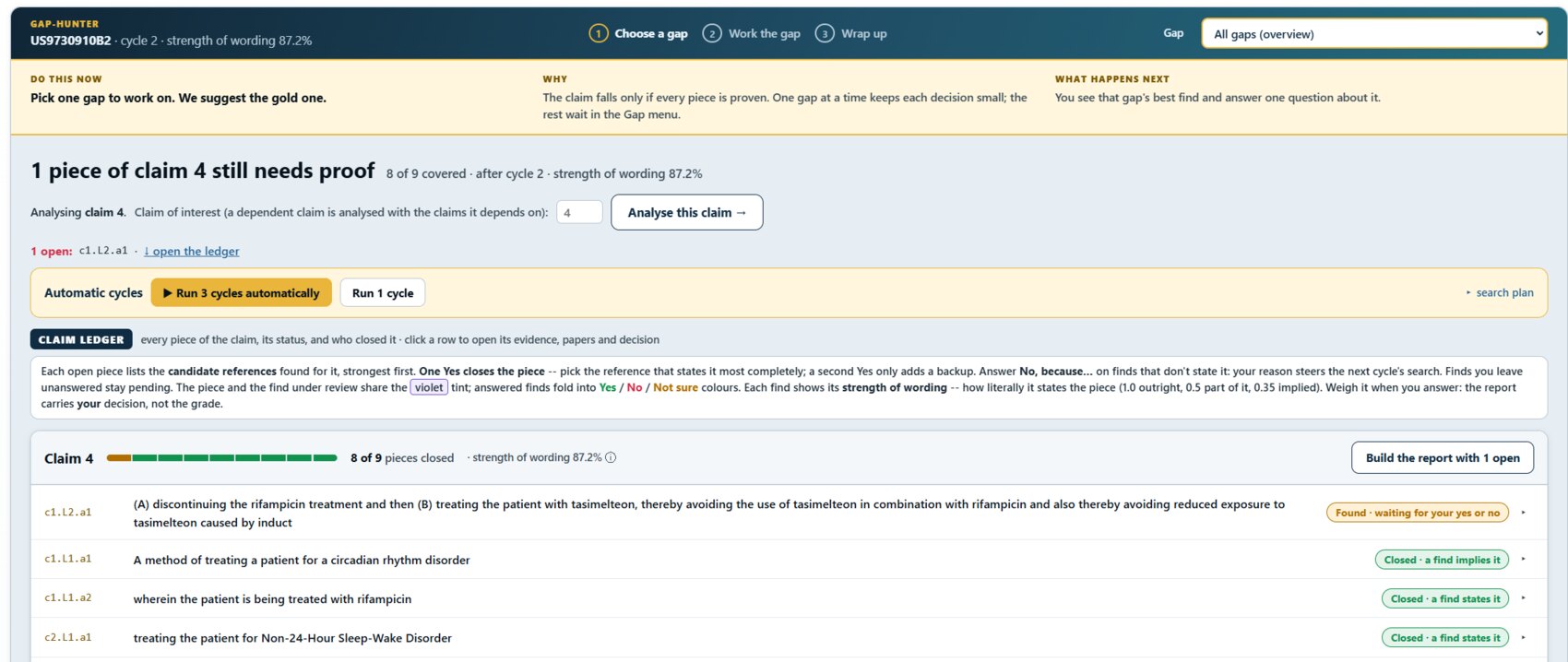
The element the case turns on — stop the rifampicin, then treat with tasimelteon — is stated nowhere in the pre-2012 art, because nobody had written about the two together. What the art does state is the same interaction for ramelteon, a sister compound on the same metabolic pathway. The court's finding rests on bridging the two.
After grading 320 date-eligible references, the system's verdict on its own best document was exactly that: the teaching is implied, not stated — the reference supports a rationale for discontinuation, though it does not mention tasimelteon. It did not round that up to a match, and it did not bury it. It put the document and the grade in front of the researcher and asked. With the evidence on screen, the researcher made the inference the court made. The system supplied the document and the precise strength of its wording; the person supplied the judgment only a person can sign.
“Each find shows its strength of wording — how literally it states the piece. Weigh it when you answer: the report carries your decision, not the grade.”
Claim ledger, in the productOne qualification, disclosed rather than buried. The find promoted for judgment was not the strongest the system held — the full coverage matrix carried a second route to the same element, confirmed on full text.
The case. Vanda Pharmaceuticals v. Teva Pharmaceuticals USA, C.A. 18-651 (D. Del.), opinion 13 December 2022, affirmed at Fed. Cir. No. 23-1247 on 10 May 2023. The opinion names the references the court relied on.
The references. WO2007137244A1 is the one to read first: confirm it teaches 20 mg once daily before bedtime for circadian rhythm sleep disorders, and confirm it says nothing at all about rifampicin. That absence is why the search had to be built to let both kinds of document in separately.
The offer that settles it. Pick a patent — preferably one with an outcome we have not seen, or no outcome at all. We will run it from the patent number, date-gated, with you watching, and you keep the output whatever it shows.