
Four of them, arguing against each other — over references found in the record, dated before priority, and quoted from their own text — so no single model's blind spots decide what you sign.
Reporter finds it. IPVerifier™ tests it. You sign it.
The Compared reference describes methods of administering the melatonin receptor agonist designated as MA-1 (tasimelteon). It targets adult patient populations in need of circadian entrainment…
Four independent vendors, different training, one source text. Where they disagree, the disagreement is kept and shown to you. Seats are filled per run from the models your licences allow; vendors are selectable and upgradable through the IPVectors licence manager, and no vendor sees another's argument.
A granted patent is not proof the art was searched — only that nothing disqualifying surfaced in the time available.
GAO-16-479 (2016) · Frakes & Wasserman, 72 Vand. L. Rev. 975 (2019) · USPTO study of CY2021 IPR final written decisions (2024)
What a court asks is how you found them, and whether the person who signed can answer for it.
AI is fast, and it routinely invents references that do not exist. In most work that is an annoyance. In a client report, an office-action response or a brief, it ends the conversation — and the person who answers for it is the one who signed.
Counts from the Charlotin database of AI-hallucination cases, as tallied by Vaquill's sanctions tracker, 12 October 2026. These are legal-research citations; prior art is a harder version of the same failure.
Next: Why you can't just ask an LLM, or fire off an agentFive plain reasons, starting with the one that matters most.↓Both will hand you a confident answer in seconds. Neither can tell you how much of it to trust, and neither can stand behind it in a room where someone is paid to take it apart.
Prior-art search is not one question. It is a run of decisions: which part of the claim is still open, whether a reference states it or only implies it, which neighbouring patent class or which journal to look in next. A person with the file in front of them makes those calls better than any model, and each call should sharpen the next search. IPVectors is built that way. Every cycle widens the search across patent classes and scientific literature, and the researcher's yes or no on each find steers where the next cycle goes. Ask an LLM once and you get one pass with no one at the wheel. An agent will take more passes, but it decides what to keep by itself, and no one has signed off on any of it.
Obviousness has to be judged as of the filing date, through the eyes of a skilled person who has never seen the patent. That is the rule, and it is also common sense: everything looks obvious once you know the answer. A model trained on the open web has read the patent, the examiner's file and, if there was one, the court's opinion. It cannot un-read them. When it tells you a combination was obvious, you cannot know whether it reasoned forward from the art or backward from the result. Opposing counsel will ask.
When a model cites a 2003 paper against a 2012 claim, there are two ways it got there. It retrieved the paper from a real index, or it recalled the citation from training, where that paper sat beside the case name a thousand times. The two look identical on the page. Only one of them is evidence. And when memory runs out, models fill the gap with references that do not exist. U.S. courts have called out lawyers in hundreds of decisions since 2024 for citing authority that was never written.
An invalidity position lives or dies under cross-examination. The person who signs it has to say how each reference was found, why it was kept, and why it reads on the limitation. A chat transcript cannot be deposed. A council of four vendors arguing against the same source text, with every grade one click from its sentence and the researcher's decision recorded, can be.
Models are probabilistic. The same question on a different day, or after a vendor's quiet update to the model, produces a different list. Evidence that changes when nobody touched it is not evidence. IPVectors runs the council at temperature zero against locked source text, so the same input gives the same answer, and the record shows that it did.
So the machine reads at a scale no person can reach and keeps a record no person would keep by hand. The person makes the calls the law requires a person to make.
What that looks like in practice: on the run in chapter 5, no pre-2012 document states the decisive step for tasimelteon. The art teaches it for ramelteon, a sister compound on the same pathway. The system found that paper, graded it as implied rather than stated, and asked. The researcher made the inference — the same one the court made. That is the division of labour, and it is the whole design.
One record of custody runs from the first search to the signed brief. The decision at every step is yours, and the report carries your decision, not the grade.
It reads the patent's own claims and works out where the art would live, then searches patent classes and scientific libraries together — including the shelf the examiner never filed in. A model is never allowed to name a reference. Every candidate is retrieved from a real index, dated before priority and quoted from its own text.
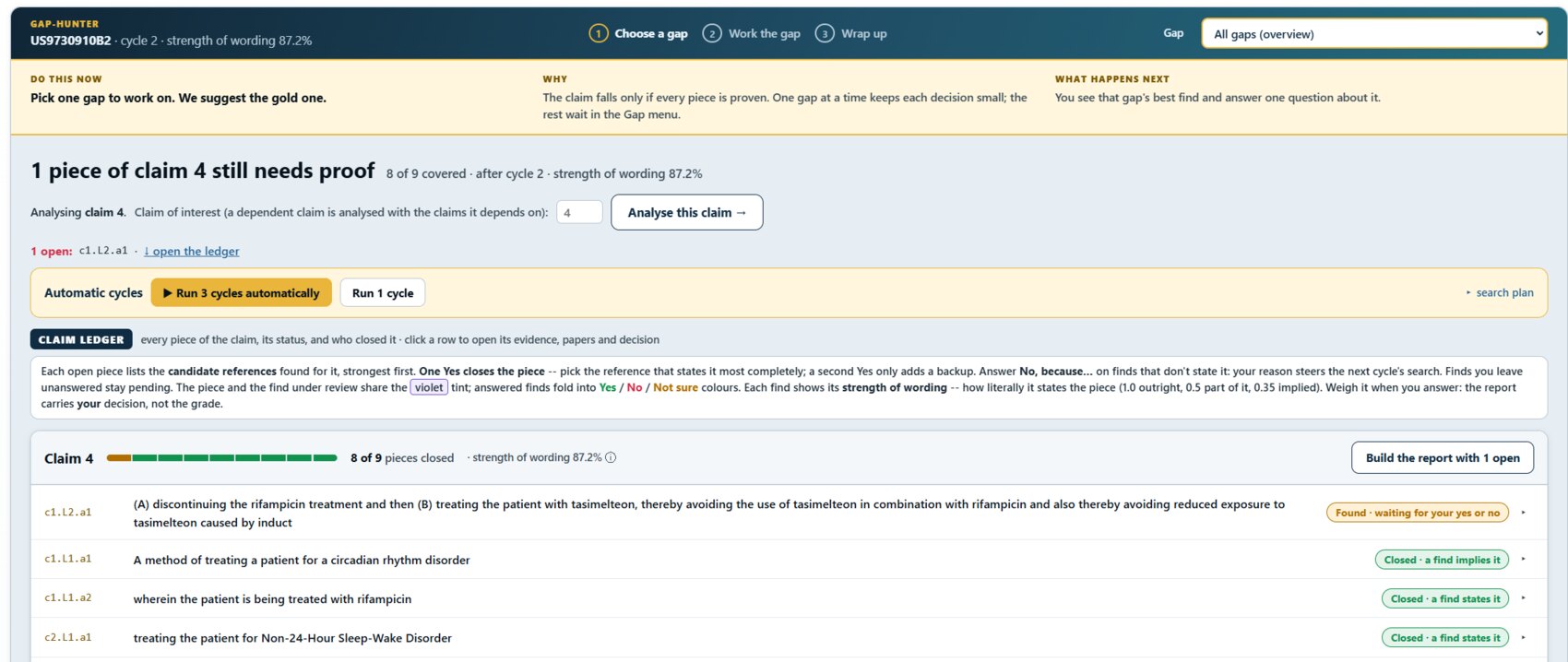
Gap-Hunter™ sits inside it: the claim is cut into pieces and each is tracked until something in the art states it. See it on a real case →
Four independent vendors — currently Grok, Claude, Gemini and GPT — argue the analysis against its own source text: one for, one against, one judging, one reviewing cold. Different training, different blind spots, one source. Where they disagree, the disagreement is kept and shown to you. At temperature zero, so the same input gives the same answer tomorrow. And the council is allowed to lose.
Runs under your own AI licences, with confidentiality controls built in. Watch one audit, step by step →
What survives becomes a Brief, and the Brief becomes one signed PDF with an independent trusted timestamp — verifiable by anyone you hand it to, including your client's experts. Every finding is one click from its sentence. Foreign-language art is translated in full, audited block by block and attested the same way.
Hours instead of weeks, without a search vendor in the loop.
An examiner searches the classes a patent was filed in, and a conventional search does the same. The document that closes the last open limitation is usually somewhere else.
Where the examiner looked. Necessary, and rarely sufficient.
Reached by following citations outward, then searching where they land.
Journal articles, conference papers, trial records — scientific libraries chosen for the field, many behind paywalls. Fetched in full, date-checked and quoted.
On the run in chapter 5, the limitation that stayed open longest was closed from shelves two and three, not shelf one.
Next: Where it's usedValidation leads. Seven adjacent jobs run on the same engine.↓Validation is where that matters most, so it is where we lead — and it is not all we do. One platform, one record of custody, for all of them.
US9730910B2 was held obvious in 2022, so the references that mattered are on the public record and a run against it can be scored rather than admired. We gave the system the patent number and nothing else, and gated every candidate to the 2012 priority date.
It surfaced both references the court relied on and graded 323 documents against the claim's nine limitations. On the decisive limitation it found the paper the inference rests on, graded it as “Implied, not stated,” and handed the call to the researcher. You can watch that happen on the Gap-Hunter page.
IPVerifier runs inside Microsoft Word, where the brief is already being written. Two public patents are loaded. Open them, run council audits, jump into the evidence — then keep going on your own AI licences, or send us a published patent of your own.
Published patents only. Send us a granted patent or a published application by its number. Do not send unpublished applications, invention disclosures, claim drafts or anything under a confidentiality obligation. We run the sample on the public record, and the result is loaded into your IPVerifier account.
Most firms stop at step three for their first real matter: samples, your own keys, then a patent of your own. Full reports and platform licences follow when you want them.